
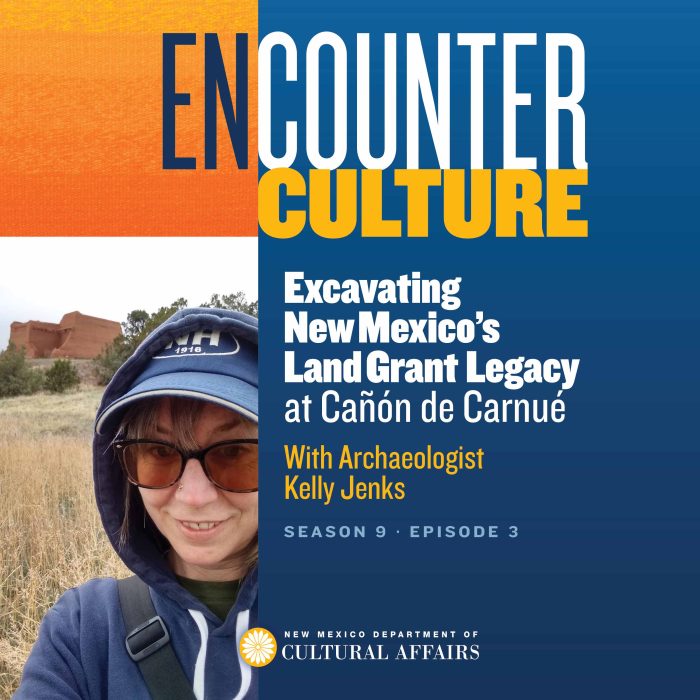
How land grant heirs and archaeologists are rebuilding history—together.

Historically, archaeological excavation has often been done by people unfamiliar with the places and sites they are researching. And all too often, this excavation resulted in looting and approaches that were not respectful of the cultures and peoples who had once resided at a particular site.
Now, community-led archaeology has gained a lot of traction as a best practice rooted in respect and also because when archaeologists work with communities it becomes easier to find answers or to know the right types of questions to ask. In the case of the Cañón de Carnué land grant excavation, New Mexico State University (NMSU) has partnered with the Cañón de Carnué land grant heirs to piece together the history of the community who first populated the site in 1763. Like all New Mexico history, this particular land grant excavation reveals the many cultures and peoples who have been a part of making the state what it is today.
“A lot of these late 18th-century land grants … were being awarded more by the colonial [Spanish] government because they were part of sort of an effort on their part to consolidate their frontier,” says Dr. Kelly Jenks, historical archaeologist with NMSU. “They were … establishing these fortified settlements in peripheral areas to try to protect the colonial core from attack, and also to kind of solidify the frontier. But, because these were pretty dangerous lands that they were looking to settle, and because they were really concerned with them being defended, they were actually, in some cases, specifically recruiting people who were identified in records as Genízaro people who had Indigenous ancestry, but oftentimes had been raised within colonial society.”
Discover more:
Archaeology in Cañón de Carnué, New Mexico State University
Cañón de Carnué land grant history
United States v. Sandoval Supreme Court decision stripping land grant rights
Present-day land grant actions
San Miguel del Vado land grant recovery efforts
Nación Genízara: Ethnogenesis, Place, and Identity in New Mexico, edited by Moises Gonzales and Enrique R. Lamadrid
Hear more on Encounter Culture:
A History of Genízaro Identity in the Heart of New Mexico with Dr. Gregorio Gonzales, Encounter Culture season 6
***
We’d love to hear from you! Let us know what you loved about the episode, share a personal story it made you think of, or ask us a question at elpalacio@dca.nm.gov. You can write a regular email or record a short voice memo and attach it for us to listen to.
Visit newmexicoculture.org for info about our museums, historic sites, virtual tours, and more.
Our favorite way to fully experience everything they have to offer is with the New Mexico CulturePass. Reserve yours online!
If you love New Mexico, you’ll love El Palacio Magazine! Subscribe to El Palacio today.
Encounter Culture, a production of the New Mexico Department of Cultural Affairs, is produced and edited by Andrea Klunder at The Creative Impostor Studios.
Hosted by Emily Withnall, editor at El Palacio Magazine
Executive Producer: Daniel Zillmann
Technical Director & Post-Production Audio: Edwin R. Ruiz
Recording Engineer: Collin Ungerleider and Kabby at Kabby Sound Studios in Santa Fe
Editor & Production Manager: Alex Riegler
Associate Producer & Editor: Monica Braine (Assiniboine/Lakota)
Theme Music: D’Santi Nava
Instagram: @newmexicanculture and @elpalaciomagazine